Japan Cherry Blossom Season With Kids
Plan northward with Japan's sakura front to match blooms with your family's pace.
Japan cherry blossom season with kids works best when the plan follows the family. Book the essentials early, choose viewing spots by age and energy, and leave room to change the day as blooms and crowds shift. Catching peak sakura matters, but not more than making the trip work for everyone who came to see it.
Why cherry blossom season is simultaneously the best and hardest time to travel Japan with children
Cherry blossoms give different generations a reason to stop at the same place. Grandparents may know sakura from paintings, parents may remember the song from college, and children may recognize the trees from anime. The season’s mild 15–20°C temperatures also make time outdoors more comfortable than summer humidity or winter cold. That combination of shared wonder and comfortable weather is a strong reason to go.
The difficulty is that everyone else has a reason to go, too. Somei Yoshino, the variety behind the iconic pale-pink to nearly white display, peaks in a single city for only a handful of days. That narrow window concentrates demand, pushing flights and hotels well above shoulder-season rates. At famous spots such as Ueno Park and Philosopher’s Path, crowds make moving with strollers or slow walkers genuinely difficult. For families, these pressures compound because the rooms and routes that suit them are also the hardest to secure.
How the sakura front actually moves, and what that means for building a family itinerary
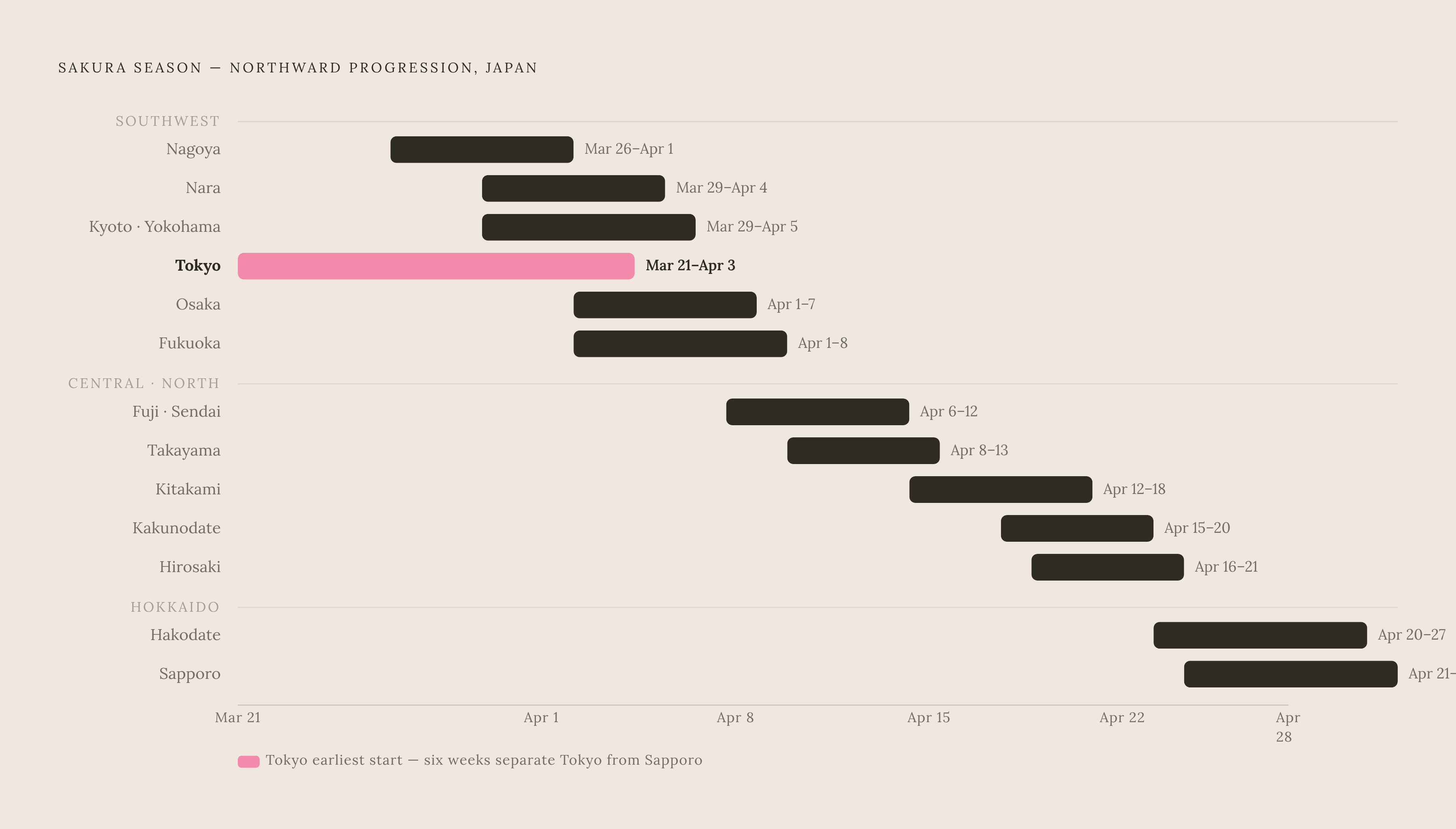
Japan does not have one national peak week. The sakura front moves northward, broadly from Kyushu and Kansai in late March toward Tohoku and Hokkaido through late April. If one region’s window is missed or its crowds are unacceptable, another part of the bloom circuit may fit better. Families need to find where the flowers meet their available dates.
The official Go Tokyo guide forecast Tokyo’s 2026 flowering to begin March 21, with full bloom roughly one week to 10 days later. The other city windows are approximate planning references. Nagoya’s window is March 26 – April 1, followed by Kyoto and Yokohama at March 29 – April 5 and Nara at March 29 – April 4. Osaka’s window is April 1 – 7, while Fukuoka’s is April 1 – 8. These overlapping dates show why moving between nearby cities is not the same as buying much more bloom time.
Later options stretch the season more clearly. Fuji Five Lakes, Fukushima and Sendai have viewing windows of April 6 – 12, while Takayama’s is April 8 – 13. Farther north, Kitakami’s is April 12 – 18, Kakunodate’s is April 15 – 20, and Hirosaki’s is April 16 – 21. Hakodate follows at April 20 – 27, with Sapporo at April 21 – 28. For families traveling late in April, Hokkaido offers a way to see the blossoms when it is too late for an earlier route.
The Japan Meteorological Corporation uses AI to forecast first flowering and full bloom at roughly 1,000 destinations nationwide. From January onward, its forecasts tell families when the trees are likely to bloom. That data can guide routing, but the weather still determines the flowers. The front is something to follow at a workable pace with children.
Matching viewing spots to age groups rather than Instagram rankings
A famous view is not automatically a good family outing. For babies and toddlers aged 0–3, flat ground, paths that a stroller can use and room to stop make it easier to move around and take breaks. Tokyo Ueno Park, Kyoto Maruyama Park and Osaka Expo Park offer flat, spacious grounds and wide lawns beneath the trees. Ueno is far easier early in the morning than when peak crowds fill its paths.
Chidorigafuchi Moat offers rowboat rental under the trees, while Sumida Park pairs cherry blossoms with views of Tokyo Skytree. Ueno’s over 1,000 trees, food stalls and festive atmosphere suit families who want a lively outing. By contrast, Shinjuku Gyoen is quieter than Ueno, and its multiple sakura varieties extend the viewing window. Those parks offer different kinds of days, each suited to a different idea of the “best” outing.
Tweens and teenagers do not necessarily want the same pace or atmosphere as younger children. Older children can enjoy an evening by Nakameguro’s lantern-lit Meguro River as a change from walking through a park by day. Grandparents can take a slow walk along the canal on Kyoto’s Philosopher’s Path before the crowds build. Maruyama Park offers a different evening scene around its illuminated weeping cherry. Across major cities, visiting famous spots before 8 a.m. and choosing weekdays over weekends are the clearest crowd-management tactics.
Why Kyoto in peak bloom requires a harder look than most family guides give it
Kyoto is spectacular in bloom, but beauty does not make its logistics easy. Crowds, restaurant demand and temple reservation systems overlap during the same short period. A family can have the dates right and still struggle to make the day work. Tokyo handles crowds better structurally, so concentrating there and saving Kyoto for another trip is a legitimate choice. It is not a lesser version of the holiday.
If Kyoto is non-negotiable, timing needs more attention than a standard Tokyo-and-Kyoto itinerary suggests. Some temples implement reservation systems during cherry blossom peaks, so knowing which sites are capped matters as much as knowing which trees are flowering. A plan made months earlier cannot tell the family which places they can enter each day. The same need for advance thought applies to meals, since Kyoto restaurants book months ahead in sakura season. Restaurants that serve kaiseki sets, kids’ menus and warm dishes can give each generation food they like.
Kiyomizu-dera or Heian Shrine can be the morning’s core sight. From there, the day needs to accommodate different energy levels instead of demanding that everyone keep going together. Kyoto can work for families who accept that trade-off. It is a harder fit for those whose plan depends on covering every famous sight at peak bloom.
The festival cancellation near Mount Fuji and what it changes for families planning around it
The 2026 cancellation of the cherry blossom festival near Mount Fuji removes an event from the area’s blossom season. Sakura scenery in the area’s public parks, streets and temple gardens remains accessible. Fuji Five Lakes has a viewing window of April 6–12. Families therefore need to distinguish a visit built around the landscape from one built around the festival.
That distinction changes the planning task. A festival once supplied an anchor for the Fuji-area day, but families who relied on it now need a substitute itinerary. Local specialists and AI itinerary tools can help plan that day around what the family likes and how much energy they have.
How families should pace each day to prevent the energy collapse that ruins the trip
Over-scheduling is the central failure mode of multi-generational sakura travel. Younger family members may want more temples, grandparents may be flagging by midday, and teenagers may want independent time. Those differences need a daily shape agreed before the group is tired. Otherwise, the itinerary keeps asking for energy that some family members no longer have.
The workable rhythm is one core sight together in the morning, a midday split, and an evening reunion at the onsen ryokan. Grandparents return to the hotel to rest, while parents take children to a park or activity. The plan should also give teenagers the time on their own that they want. The split protects the time everyone spends together from becoming a test of endurance.
With a baby, a morning visit to Ueno, Maruyama or Expo Park gives the family flat, open ground before stalls and hanami groups fill the paths. Transport needs similar attention at the other end of the day. For groups with three generations, a private vehicle such as the 7–8 seat Toyota Alphard keeps everyone together door-to-door, so grandparents can leave their luggage in the vehicle and tired travelers can skip train transfers. With Tokyo street taxis exceptionally hard to secure during sakura season, private transport can be a practical necessity for these groups.
The trip also needs a clear main thread. Trying to fit cherry blossoms, Universal Studios and teamLab into one holiday makes it harder to take the slower pace that makes sakura travel fun. Making the blossoms the focus, with other activities woven around them, avoids turning each day into a competing set of demands. Mild weather and the act of viewing the flowers already support an unhurried outing. The plan does not need to fight that rhythm.
When to book and what sells out first for families
Early booking is less about finding a bargain than securing a trip that physically works. Families most need larger rooms, connecting rooms and hotels near major stations, all of which are in short supply. A city may still have hotel availability after those options are gone. That distinction matters because a room somewhere is not necessarily a workable room for children and grandparents. The rooms that suit families can be booked up before many families from overseas start to plan.
The booking cycle can start in May or June of the prior year. Fuji-view ryokan family rooms can close to bookings by June, around nine months before the March–April bloom window. Restaurants also need to be arranged months ahead. The same early conversation should cover the vehicle and table configuration the group needs. These are the foundations of the trip.
Families should bring up any special needs when they first discuss the plan. A baby, grandparents with mobility considerations and teenagers who want independent time each change the route or daily structure. Declaring those needs early matters because sakura itineraries have little room for major changes once the scarce pieces are set. That is a prompt to act.
For families who have missed the main booking window, Izu Kawazu early sakura offers a concrete alternative in late February. Prices are meaningfully lower than peak sakura, and crowds are far smaller. The trade is a display earlier than peak Somei Yoshino. For a family whose priority is seeing blossoms together without the heaviest logistical pressure, that is a useful option.
Why flexibility — not a fixed itinerary — is the most important thing a family can pack for sakura season
Rooms, transport and meals need a firm foundation, while daily sightseeing needs room to respond to weather, bloom progress and access limits. Certain Kyoto temples use peak-season reservation systems, and Mount Fuji has paid permits with daily quotas. Those access restrictions apply to distinct places. Useful planning identifies what applies to the actual place the family intends to visit.
A good planning conversation therefore starts with lifestyle and pace alongside destinations and dates. Toddlers and grandparents need a different day from independent teenagers. An AI travel assistant earns its place when it brings those differences into the plan early and uses current information to suggest suitable changes. It helps the family choose a workable alternative when a bloom window shifts, a site is capped or an event is cancelled.
The family needs secure essentials, age-appropriate choices and enough room to change course without undoing the holiday. With those pieces in place, the flowers can guide a flexible day. That is how Japan’s most time-pressured season becomes a trip the whole family can enjoy.
Notes
- When and where to see cherry blossoms in Tokyo in 2026
Provided the 2026 Tokyo flowering start date and the city-by-city bloom window dates used throughout the itinerary planning section.
Every new piece from Little Legs Abroad, as it's published.
Follow